Additional information
| Weight | 800 g |
|---|---|
| ISBN | 906299346X, 9789062993468 |
| Publication Year | 2026 |
| Editors | Han Luijkx, Ineke de Noord, Jelmer Weijs, Maarten Belgers, Marleen Arends, Mary Janssen van Raay, Mimi Pierce, Tim van Grinsven |
€44,95 excl. VAT
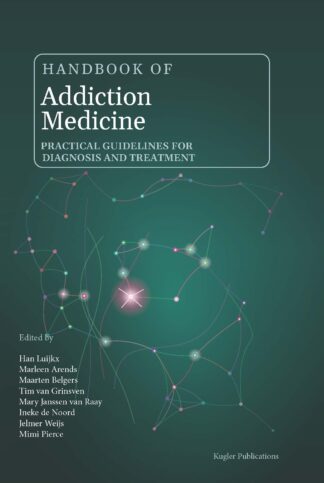
Addiction medicine is an essential part of clinical practice. Although substance use is still widely regarded as a matter of
free will, both its onset and the risk of progression to harmful use and addiction are shaped by a complex interplay of biological,
psychological, and social factors. Substance use disorders are common, and almost every health professional will encounter
patients affected by them. Their consequences extend well beyond the individual patient into society at large.
The Handbook of Addiction Medicine brings medical knowledge, clinical expertise, and multidisciplinary collaboration together
in a single, practice-oriented reference. Grounded in current evidence-based guidelines, the DSM-5-TR, and recent literature,
it covers the full breadth of the field—from acute intoxication and detoxification through long-term treatment and recovery
support—with attention to both pharmacological and nonpharmacological interventions, as well as somatic and psychiatric
comorbidities.
The twenty-seven chapters are organized in four parts: general principles, including recovery-oriented and palliative care; disorders involving specific substances; behavioral addictions; and care for specific populations, such as older adults, people with mild intellectual disability, and patients in forensic settings. The chapters follow a uniform structure, highlight points of attention,
and conclude with key learning points, allowing essential guidance to be located at a glance.
This English edition of a Dutch standard work has been thoroughly revised and adapted for an international readership. It is intended for physicians, medical students, nurses, nurse practitioners, psychologists, and any other health professionals working in or alongside addiction medicine. Its clear structure makes it equally suitable as a quick reference, a teaching resource, and a practical
companion in daily clinical practice.
FOREWORD
INTRODUCTION
PART 1: GENERAL
1. ADDICTION AND PERSPECTIVES ON RECOVERY
2. PALLIATIVE AND CHRONIC CARE
3. ACUTE INTOXICATION AND TOXIDROMES
PART 2: ADDICTION TO PSYCHOACTIVE SUBSTANCES
4. NICOTINE
5. ALCOHOL
6. CANNABIS
7. OPIOIDS
8. BENZODIAZEPINES AND OTHER SEDATIVES
9. STIMULANTS
10. HALLUCINOGENS
11. GAMMA-HYDROXYBUTYRIC ACID (GHB)
12. NITROUS OXIDE
13. KETAMINE
14. NEW PSYCHOACTIVE SUBSTANCES
15. POLYSUBSTANCE USE
PART 3: BEHAVIORAL ADDICTIONS
16. INTRODUCTION TO BEHAVIORAL ADDICTIONS
17. GAMBLING
18. GAMING
PART 4: SPECIFIC TARGET GROUPS
19. YOUNG PEOPLE
20. OLDER ADULTS
21. SUBSTANCE USE DURING PREGNANCY
22. PATIENTS WITH A MILD INTELLECTUAL DISABILITY AND BORDERLINE INTELLECTUAL FUNCTIONING
23. PATIENTS WITH A DUAL DIAGNOSIS
24. FORENSIC ADDICTION TREATMENT
25. COMPULSORY MENTAL HEALTHCARE IN ADDICTION TREATMENT
26. INDIVIDUALS WITH ACUTE BEHAVIORAL DISTURBANCES IN PUBLIC SPACES
27. CHEMSEX
APPENDIX
CONTRIBUTORS
INDEX
As Chair of the Netherlands Society for Addiction Medicine (VVGN), it is a great pleasure and privilege to introduce this handbook, which is the culmination of many years of work. Its origins lie in the ambition of former VVGN board member and current honorary member Han Luijkx to create a practical and authoritative handbook of addiction medicine. His initiative gradually gained wider support and ultimately developed into the collaborative project represented by this volume. The result is an accessible, clinically focused, and comprehensive handbook of addiction medicine. What I particularly value is that not only my esteemed fellow addiction medicine specialists contributed to it, but that broader knowledge and expertise were brought in as well. That makes the book stronger and even more relevant. The digital edition also makes it possible to keep the handbook current as evidence and clinical practice evolve. The VVGN is committed to supporting both its use in practice and its continued development.
That commitment to keeping the handbook current has now led to a further step. The original edition was written primarily for clinical practice in the Netherlands. On the occasion of the VVGN hosting the 2026 Congress of the International Society of Addiction Medicine in Rotterdam, the handbook has been thoroughly revised and adapted for an international readership. This is not simply a translation of the Dutch edition. The chapters have been updated in line with current evidence-based guidelines, DSM-5-TR, and recent scientific literature. National epidemiological data, legislation, healthcare structures, and patient resources have, where appropriate, been replaced by European or international sources and frameworks, while specifically Dutch practices are placed in a
broader international context. What has deliberately been preserved is the character of the original: the consistent chapter structure, the points of attention, and the key learning points that allow essential guidance to be found at a glance.
The handbook reflects the remarkable breadth and complexity of contemporary addiction medicine. It addresses the fundamental principles and clinical perspectives that underpin our field; the recognition, assessment and treatment of substance use disorders and behavioral addictions; the pharmacology, acute effects and long-term
consequences of individual psychoactive substances; pharmacological and psychosocial interventions; and the management of medical and psychiatric comorbidity. It also considers the ethical, legal and societal questions that inevitably accompany the care of people affected by addiction. Together, these subjects illustrate how addiction medicine extends far beyond the treatment of substance use alone. It is a field concerned with the whole person, often across many years and at some of the most vulnerable moments in a patient’s life.
That breadth is also what makes addiction medicine such a challenging and rewarding area of medical practice. Although our knowledge has advanced considerably, much remains to be understood. New psychoactive substances continue to emerge, patterns of use change, treatment options evolve, and our understanding of the biological, psychological, and social determinants of addiction continues to develop. There is therefore an ongoing need for scientific research, critical reflection, and the translation of new knowledge into clinical practice.
There is also a need to strengthen addiction medicine as a professional field. Too few physicians are exposed during their training to the full scope and intellectual richness of our specialty. Skepticism can still prevail in the medical world regarding possibilities of recovery of addiction. Yet those who enter the field discover a discipline that combines acute medicine with long-term care, scientific complexity with human connection, and
highly specialized knowledge with some of the most fundamental questions in medicine: how illness affects autonomy, how behavior and biology interact, how change becomes possible, and how we can continue to provide care even when recovery is neither immediate nor straightforward.
Ultimately, however, the value of a handbook such as this is measured not by the number of subjects it covers, but by whether it contributes to better care. People with substance use disorders and behavioral addictions continue to experience substantial medical and psychiatric morbidity, social disadvantage and stigma, and they do not always receive the timely, evidence-based, and compassionate care they need. As professionals, we therefore have a continuing responsibility to improve not only the scientific quality of addiction treatment, but also its accessibility, continuity, and humanity.
As the VVGN we are proud to present this international edition and deeply grateful to everyone who has contributed to its creation. Our thanks go to the editors, authors and reviewers who devoted their time, expertise, and critical judgement to revising and updating the chapters, to all those whose work made the original Dutch edition possible, and to the publisher for supporting the development of this international volume.
We hope that colleagues across countries and disciplines will find this handbook a valuable companion in clinical practice: a source of knowledge when decisions are difficult, a practical guide when information is needed quickly, and an invitation to continue developing a field that has much to offer both medicine and the people we serve.
Dr Wilco Sliedrecht
Chair, Netherlands Society for Addiction Medicine (VVGN)
Addiction medicine specialist (KNMG)
| Weight | 800 g |
|---|---|
| ISBN | 906299346X, 9789062993468 |
| Publication Year | 2026 |
| Editors | Han Luijkx, Ineke de Noord, Jelmer Weijs, Maarten Belgers, Marleen Arends, Mary Janssen van Raay, Mimi Pierce, Tim van Grinsven |