Additional information
| Editors | |
|---|---|
| ISBN | 978-90-6299-336-9 |
| Publication Year | 2026 |
Part of WGA Consensus Series
Volume 12
€60,00 excl. VAT
FACULTY vii
FOREWORD xiii
PREFACE xv
DEFINITIONS OF ANGLE CLOSURE xvii
1. EPIDEMIOLOGY 1
David Friedman, Mingguang He, Ching-Yu Cheng, Ronnie George
2. GENETICS AND PATHOPHYSIOLOGY 29
David Friedman, Paul Foster, Monisha Nongpiur, Ningli Wang
3. DIAGNOSIS AND EVALUATION 63
Tin Aung, Benjamin Xu, Kyungrim Sung, Christopher Leung
4. MANAGEMENT: MEDICAL AND LASER 125
Tin Aung, Mani Baskaran, Shan Lin, Lisandro Sakata, Gus Gazzard
5. SURGICAL MANAGEMENT 183
Xiulan Zhang, Benjamin Xu, Clement Tham, Tanuj Dada, Do Tan
6. ACUTE PRIMARY ANGLE CLOSURE 263
Xiulan Zhang, Paul Foster, Sasan Moghimi, Vijaya Lingam
SUMMARY OF CONSENSUS POINTS 305
INDEX OF AUTHORS 317
EXTENDED TABLE OF CONTENTS 319
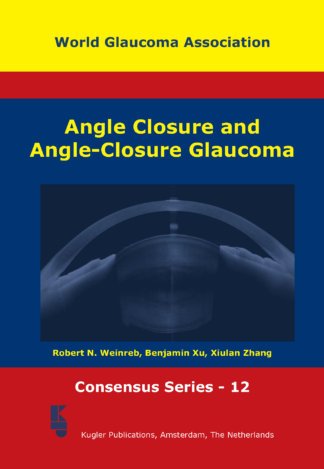
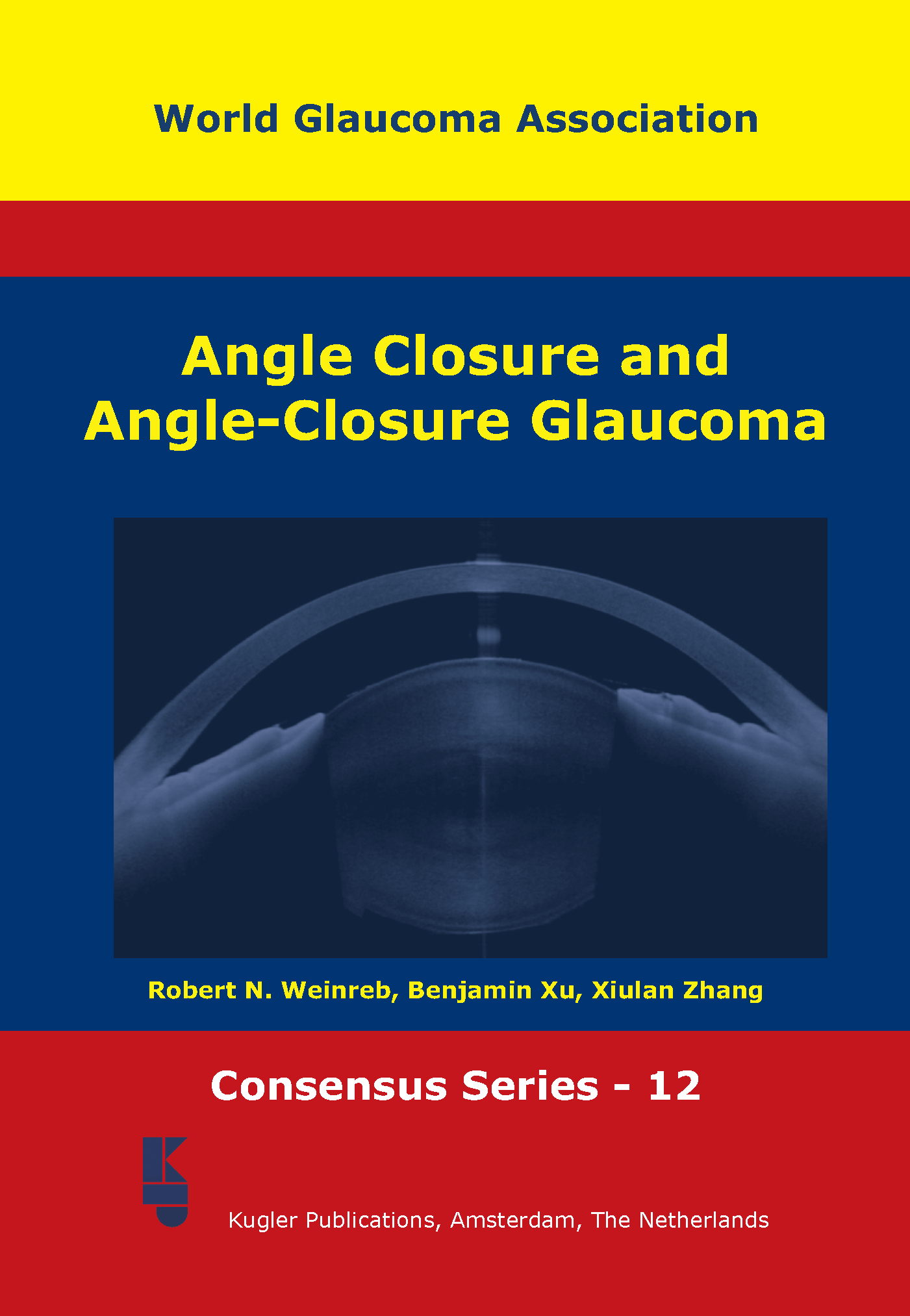
The topic for World Glaucoma Association Consensus 12 was angle closure and angle-closure glaucoma. Global experts were invited and assembled by our international Co-Chairs, beginning in June 2024, to draft a literature review and participate in an online discussion on this topic. Consensus was reached for each of the six sections on key issues relating to definitions, diagnosis, and management. The results of these thoughtful discussions were then summarized with preliminary consensus statements for each section. The draft of the Consensus Report, including the preliminary consensus statements, was distributed to the Section Leaders prior to the Consensus Meeting, which took place in Honolulu on Tuesday June 25, 2025.
During the meeting, the Co-Chairs, Section Leaders, and participants engaged in a lively and thought-provoking session to review and revise the consensus statements. With the foundational consensus statements, the Co-Chairs and Section Leaders oversaw the updating of their respective texts. The wisdom that emerged from the group surpassed the influence of any individual expert. The Consensus Report was then finalized by the Co-Chairs and editors.
Throughout the process, it was challenging to reach consensus on subject matters for which clinical opinions vary widely and practice patterns are highly diverse. In large part, this reflects the often limited evidence that guides current clinical practice. Hence, this Consensus is based not only on the published literature, but also on expert opinion. Although consensus does not replace, nor is it a surrogate for, scientific investigation, it does provide considerable value, especially when the desired evidence is lacking.
The goal of this Consensus is to provide a foundation for diagnosing and managing angle closure and angle closure glaucoma. It also seeks to identify those areas lacking in evidence where there is a need for additional research. In other words, this Consensus Report can serve as a benchmark of our understanding of what is known and what we would still like to know.
Robert N. Weinreb, Consensus Chair
Benjamin Xu, Consensus Co-Chair
Primary angle-closure glaucoma (PACG) remains a leading cause of irreversible blindness worldwide. Even though primary open-angle glaucoma (POAG) is more prevalent, it has been estimated that nearly half of all global glaucoma-related blindness is attributable to PACG due to its greater severity and more aggressive course. As populations age, the number of individuals affected by PACG is expected to rise substantially, underscoring the need for clear, evidence-based strategies to address this growing global burden.
Since the last World Glaucoma Association (WGA) consensus on angle-closure glaucoma in 2006, numerous landmark studies have transformed our understanding of this potentially blinding disease. Population-based epidemiological studies have provided more accurate estimates of the prevalence, global distribution, and associated ocular morbidity of angle closure and PACG. Our understanding of disease pathogenesis, especially regarding racial anatomical differences and dynamic iris-related mechanisms, has also advanced. Anterior segment optical coherence tomography (AS-OCT) has emerged as a key modality for detecting and risk-stratifying individuals at risk for PACG, complementing gonioscopy, the long-standing clinical reference standard. The integration of artificial intelligence (AI) may further enhance the efficiency, accessibility, and scalability of OCT-based assessment. At the same time, landmark clinical trials such as EAGLE and ZAP have expanded the evidence base for managing angle closure, supporting more precise and individualized decision making across a growing range of treatment options, such as clear lens extraction. Goniosynechiolysis and minimally invasive glaucoma surgery (MIGS) show promise, but require further evaluation to define their precise role, benefits, and cost-effectiveness. Together, these developments underscore the need to synthesize recent clinical and scientific advances and identify the critical knowledge gaps that warrant future study.
Identifying best practices for angle closure and angle-closure glaucoma has become increasingly challenging as the literature expands at a rapid pace. As with prior WGA consensus statements, the current Angle Closure Consensus synthesizes both published evidence and expert clinical experience. Although consensus guidelines are not a substitute for rigorous scientific investigation, they serve an important function, particularly in areas where high-quality evidence remains limited. The aim of this consensus is to clarify what is currently established and highlight the key unanswered questions needed to advance our understanding of disease mechanisms and refine screening and treatment strategies for angle closure. This report is intended to serve as a reference point for the field, with the expectation that it will evolve as new data emerge and clinical practice continues to advance.
Consensus Co-Chairs
Benjamin Xu
Tin Aung
Paul Foster
David S. Friedman
Xiulan Zhang
Robert N. Weinreb
| Editors | |
|---|---|
| ISBN | 978-90-6299-336-9 |
| Publication Year | 2026 |